
An SCHD dividend calculator can help investors estimate how dividend income may change over time. It can also show how reinvesting dividends and adding money regularly may affect future results.
The calculator does not predict the future. Instead, it uses the numbers entered by the user to create a mathematical estimate.
This guide explains how to use an SCHD dividend calculator, what each input means, and how to read the results correctly.
1. Understand What an SCHD Dividend Calculator Does
An SCHD dividend calculator estimates potential dividend income from an investment in SCHD.
The basic calculation starts with three things:
- Investment amount
- Number of shares
- Dividend per share
For example, suppose someone invests $5,000 and the assumed share price is $40.
The estimated number of shares would be:
$5,000 ÷ $40 = 125 shares
If the assumed annual dividend is $1.20 per share, the estimated yearly dividend would be:
125 × $1.20 = $150
The calculator can then extend this calculation across multiple years.
2. Enter the Initial Investment
The initial investment is the amount used to start the calculation.
For example, a user might enter:
Initial investment: $10,000
The calculator uses this amount to determine the starting number of shares.
A larger starting investment generally produces more starting shares. More shares can also produce more dividend income when the assumed dividend per share stays the same.
However, the calculation depends on the assumptions entered into the tool.
3. Add the Assumed Share Price
The share price determines how many SCHD shares the starting investment can purchase.
For example:
Investment: $10,000
Assumed share price: $40
The estimated shares would be:
$10,000 ÷ $40 = 250 shares
A different share price would produce a different share count.
Therefore, users should always check whether the calculator uses a current price, a manually entered price, or an assumed future price.
4. Enter the Dividend Amount
The dividend input represents the assumed dividend paid for each share.
Suppose the calculator uses an annual dividend assumption of $1.25.
With 250 shares, the estimated annual dividend becomes:
250 × $1.25 = $312.50
This is an estimate rather than a guaranteed future payment.
Dividend amounts can change over time, so the result should be viewed as a projection based on the selected assumption.
5. Estimate the Starting Dividend Income
Once the starting shares and dividend amount are available, the calculator can estimate the initial dividend income.
The basic formula is:
Shares × Annual Dividend Per Share = Annual Dividend Income
For example:
| Input | Example |
|---|---|
| Investment | $10,000 |
| Share price | $40 |
| Estimated shares | 250 |
| Annual dividend per share | $1.25 |
| Estimated annual income | $312.50 |
The same income can also be converted into a quarterly estimate when the assumed dividend is paid four times per year.
6. Choose How Dividends Are Handled
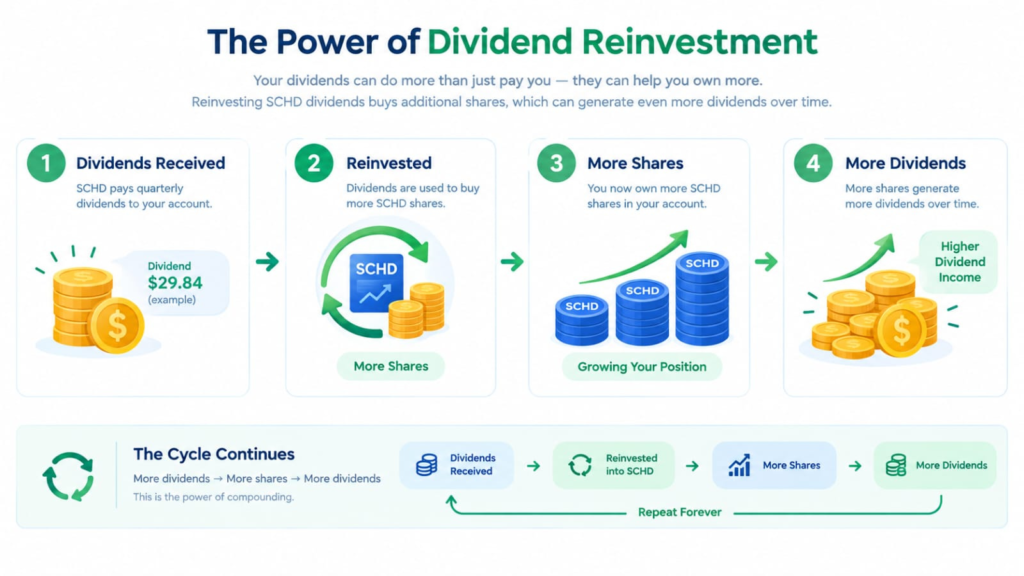
A calculator may allow users to choose between receiving dividends as cash or reinvesting them.
With cash dividends, the estimated payments leave the investment instead of buying additional shares.
With reinvestment, dividends are used to purchase more shares.
Those additional shares can generate dividends in later periods.
This creates a compounding effect that can become more noticeable over longer periods.
7. See How Dividend Reinvestment Can Change Results
Dividend reinvestment is often called DRIP.
The basic idea is simple:
Dividends → Additional shares → More future dividends
For example, imagine an account receives $100 in dividends.
If those dividends are reinvested, the $100 can purchase additional shares based on the assumed share price.
Those new shares may then contribute to future dividend income.
A calculator with a DRIP option can model this process over several years.
8. Add Regular Contributions
Some SCHD calculators also allow additional investments.
These contributions can be:
- Weekly
- Monthly
- Quarterly
- Yearly
For example, a user could enter:
Initial investment: $5,000
Monthly contribution: $200
Investment period: 10 years
The calculator can then estimate how regular contributions affect the portfolio and potential dividend income.
This is useful because long-term results may depend on both the starting amount and the money added later.
9. Set the Investment Period
The investment period tells the calculator how long the assumptions should continue.
For example:
5 years
10 years
15 years
20 years
A longer period gives dividend reinvestment and additional contributions more time to affect the calculation.
However, a longer projection also means more uncertainty.
Small changes in dividend growth, share price, or contributions can create large differences over many years.
10. Enter a Dividend Growth Assumption
Some calculators allow users to enter an estimated annual dividend growth rate.
For example, a hypothetical calculation could assume dividend growth of 5% per year.
This does not mean SCHD will actually increase its dividend by exactly 5% every year.
Instead, the calculator simply applies the selected assumption to future periods.
That distinction matters when reading long-term projections.
11. Add a Share Price Growth Assumption
Some tools also include an assumed annual share price growth rate.
For example, a user might enter a hypothetical 4% annual price increase.
This assumption can affect the projected portfolio value and the price used for future share purchases.
It does not guarantee that the market will follow that path.
Actual market prices can move higher or lower from year to year.
12. Understand Yield on Cost
Yield on cost compares current estimated dividend income with the original amount invested.
The basic formula is:
Yield on Cost = Annual Dividend Income ÷ Original Investment × 100
For example, suppose someone initially invests $10,000.
If the estimated annual dividend later reaches $700, the yield on cost would be:
$700 ÷ $10,000 × 100 = 7%
This does not mean the ETF’s current market yield is 7%.
It only compares the estimated income with the original investment.
13. Compare Dividends With and Without Reinvestment
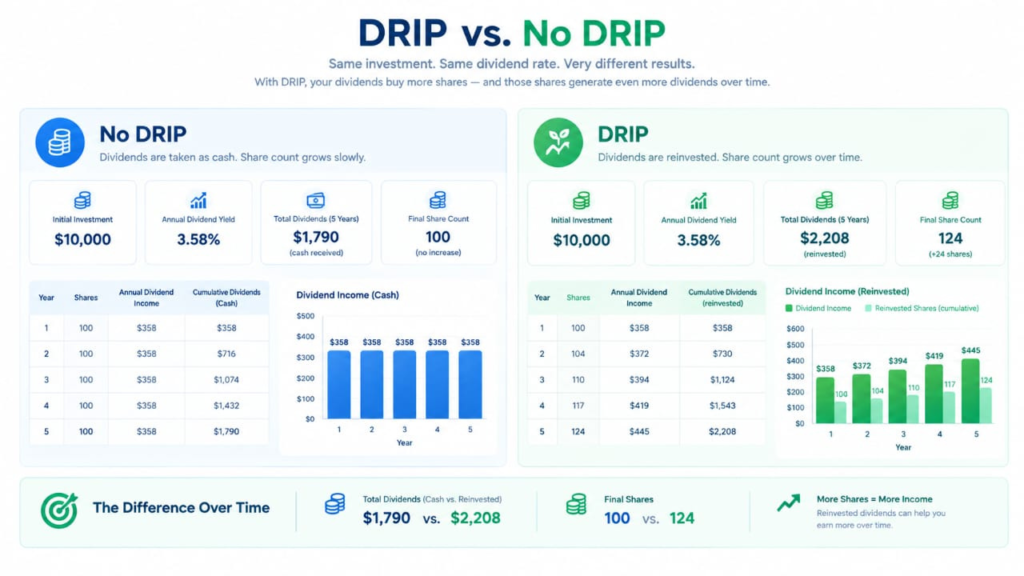
Running two scenarios can make a calculator more useful.
Scenario A: Dividends Taken as Cash
The investor receives the estimated dividends without purchasing additional shares.
Scenario B: Dividends Reinvested
The dividends are used to purchase additional shares.
The second scenario may produce a larger share count over time because the dividends are repeatedly put back into the investment.
A side-by-side comparison can therefore show how the reinvestment assumption affects the projected outcome.
14. Try a Complete Hypothetical Example
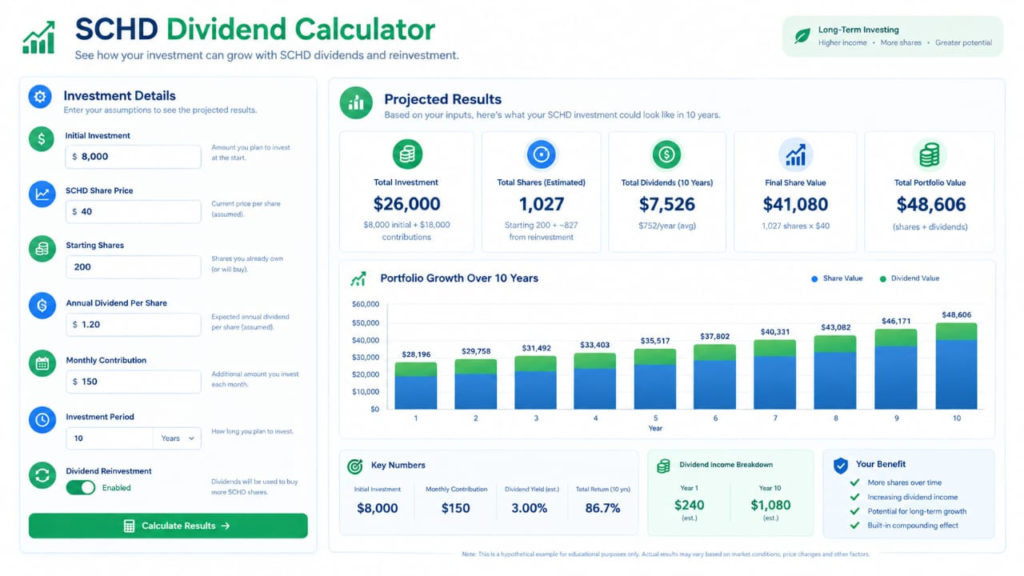
Consider a simple example:
| Input | Assumption |
|---|---|
| Initial investment | $8,000 |
| Assumed share price | $40 |
| Starting shares | 200 |
| Annual dividend per share | $1.20 |
| Monthly contribution | $150 |
| Investment period | 10 years |
| Dividend reinvestment | Yes |
The starting share calculation is:
$8,000 ÷ $40 = 200 shares
The starting annual dividend estimate is:
200 × $1.20 = $240
The monthly contribution adds another source of portfolio growth.
Meanwhile, reinvested dividends can potentially purchase additional shares.
The calculator combines these assumptions to create a long-term projection.
This example is hypothetical and does not represent a guaranteed SCHD result.
15. Avoid Common SCHD Calculator Mistakes
Several mistakes can make calculator results misleading.
Using an unrealistic dividend assumption
A very high dividend assumption can make future income appear larger than expected.
Ignoring share price changes
Share prices can affect how many shares additional money can purchase.
Treating projections as promises
A calculator follows mathematical assumptions. It cannot know future market conditions.
Forgetting contributions
A projection can look very different when regular deposits are included.
Confusing yield with yield on cost
These are different measurements and should not be treated as the same number.
Looking only at the final balance
The final portfolio value is only one part of the calculation. Dividend income, shares, contributions, and reinvestment also matter.
16. Understand the Limits of an SCHD Calculator
An SCHD dividend calculator is a planning tool, not a prediction engine.
Its output depends on the inputs selected by the user.
For example, the result can change when someone changes:
- Starting investment
- Share price
- Dividend per share
- Dividend growth
- Share price growth
- Contribution amount
- Contribution frequency
- Investment period
- Dividend reinvestment
Actual results may differ from the calculator because future dividends and market prices can change.
Taxes, trading costs, account rules, and other real-world factors may also affect an investor’s actual outcome.
17. Frequently Asked Questions
What is an SCHD dividend calculator?
An SCHD dividend calculator estimates potential dividend income and investment growth using selected assumptions.
Can an SCHD calculator show future dividend income?
Yes. A calculator can estimate future dividend income when users provide assumptions about dividends, growth, investments, and time.
What is an SCHD DRIP calculator?
An SCHD DRIP calculator models dividend reinvestment. It estimates how reinvested dividends may purchase additional shares over time.
Can I add monthly investments?
If the calculator supports recurring contributions, users can enter a monthly investment amount and include it in the projection.
Does dividend reinvestment increase the number of shares?
It can. When dividends are reinvested, they can be used to purchase additional shares.
Is calculator output guaranteed?
No. Calculator results are mathematical estimates based on assumptions. Actual future results can be different.
What is yield on cost?
Yield on cost compares dividend income with the original amount invested. It is different from the current dividend yield.
Can I use the calculator for a 10-year projection?
Yes. A calculator can model a 10-year scenario when the required assumptions are provided.
18. Final Thoughts
An SCHD dividend calculator makes dividend planning easier by turning several numbers into a clear projection.
Users can start with an investment amount, estimate their shares, add dividend assumptions, include regular contributions, and decide whether dividends are reinvested.
The most useful approach is to test different scenarios instead of relying on one result.
A conservative assumption, a longer time horizon, and a clear understanding of the calculator’s inputs can make the projection easier to interpret.
The final numbers should always be treated as estimates rather than promises about future investment performance.