
Want to know how much income your SCHD investment could generate over time? A SCHD Dividend Calculator can help you estimate potential dividend income, share growth, and future portfolio value using your investment amount and selected assumptions. Instead of relying only on today’s SCHD dividend yield, you can explore how reinvested dividends, regular contributions, and dividend growth may affect your results.
This can make long-term planning easier, especially if you’re building an income-focused portfolio. You can also compare different time periods and investment strategies to see how the numbers change. In this guide, you’ll learn how the calculator works, how SCHD dividend payments are estimated, and how DRIP can influence potential income and investment growth over time.
1. SCHD Dividend Calculator: Calculate Your Dividend Income
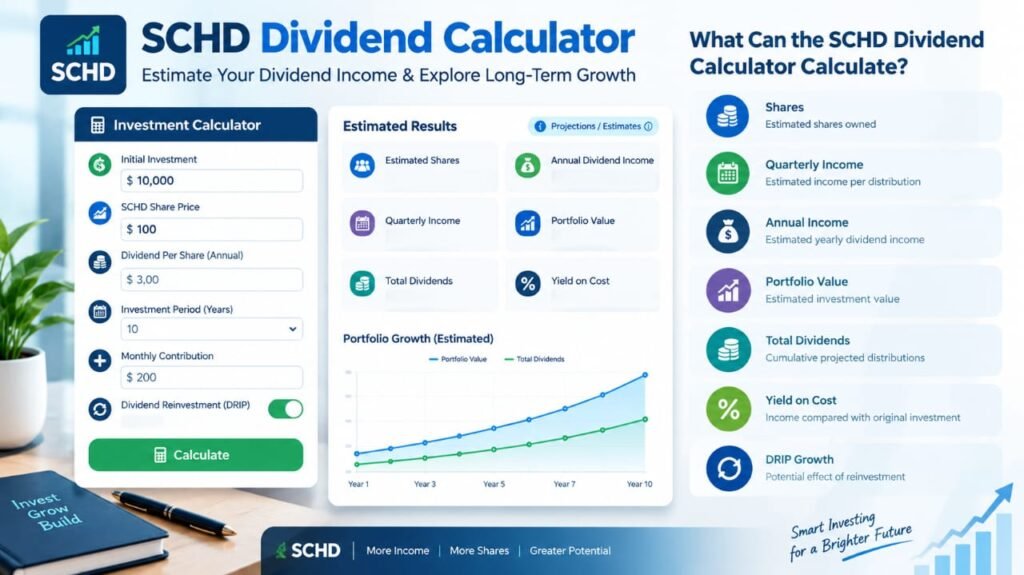
The SCHD dividend calculator helps you estimate how much income an investment could generate from distributions. You can enter an investment amount, share price, dividend assumptions, and time period. The result can show estimated shares, income, reinvested dividends, and future portfolio value.
This is more useful than looking at today’s yield alone. Your income can change as the SCHD dividend, share count, and distributions change. A longer dividend income projection can also show how reinvestment and additional deposits may affect your results over time.
What Can the SCHD Dividend Calculator Calculate?
A useful calculator can estimate SCHD dividend income, quarterly distributions, annual income, share accumulation, and potential future value. It can also compare cash dividends with reinvested dividends when DRIP is enabled.
| Calculator Result | What It Shows |
|---|---|
| Shares | Estimated shares owned |
| Quarterly income | Estimated income per distribution |
| Annual income | Estimated yearly dividend income |
| Portfolio value | Estimated investment value |
| Total dividends | Cumulative projected distributions |
| Yield on cost | Income compared with original investment |
| DRIP growth | Potential effect of reinvestment |
What Information Do You Need?
To estimate SCHD dividend income, you need a starting investment and an appropriate SCHD share price. A longer projection may also use dividend growth, share-price growth, recurring deposits, and reinvestment assumptions.
The more assumptions you add, the more useful the model becomes. However, more inputs don’t make the forecast certain. They simply let you create different scenarios and see how the results respond.
SCHD Dividend Calculator vs. a Simple Dividend Calculator
A simple dividend calculation may only multiply shares by the annual dividend. An ETF-focused model can go further by including SCHD dividend growth, contributions, reinvestment, and changing portfolio value.
That difference matters for long-term investors. A simple calculation answers an income question today. A detailed SCHD portfolio growth projection explores how income and capital could change over several years.
2. How to Use the SCHD Dividend Calculator
Using the calculator should feel more like testing a few scenarios than solving a complicated finance problem. Start with your actual investment amount. Then select a realistic time period and decide whether you want dividends paid to you or reinvested.
You can then compare different assumptions. For example, you might test $5,000 with no contributions against $5,000 plus $200 in monthly contributions. This shows how investment size and saving habits can affect the projection.
Step 1: Enter Your Initial Investment
Your starting amount determines how many shares you can initially purchase. For example, a $10,000 investment will normally create a much larger starting income stream than a $1,000 investment at the same dividend rate.
The SCHD share price also matters because it determines the approximate number of shares purchased. Since market prices move throughout the trading day, the share count can change when your assumed price changes.
Step 2: Add Your Investment Period
Choose the number of years you want to study. A one-year calculation can help estimate near-term income. A 10-year model is more useful for understanding SCHD investment growth over 10 years.
Longer periods also make compounding more visible. Small differences in contributions, dividend growth, or reinvestment can become much larger when the same process continues for many years.
Step 3: Choose Dividend and Growth Assumptions
A projection can include a starting dividend yield, expected dividend growth rate, and assumed share-price growth. These numbers are inputs, not promises.
Historical SCHD dividend growth can provide context. It should not be treated as a guaranteed future rate. The fund itself notes that past performance does not guarantee future results.
Step 4: Turn Dividend Reinvestment On or Off
If you select DRIP, the calculator assumes distributions are used to purchase additional shares. If you turn it off, dividends remain as cash income.
This creates an important comparison between SCHD dividend income with DRIP and income taken as cash. The first approach focuses more heavily on potential share accumulation. The second focuses more directly on current cash flow.
Step 5: Add Recurring Contributions
Recurring deposits can make a major difference in a long-term model. You might add $100, $250, or $500 each month. You can also model annual increases in your contribution.
This connects the calculator with dollar-cost averaging. Instead of relying entirely on one large purchase, you continue investing over time. Your actual purchase prices will vary because SCHD trades in the market.
Step 6: Review Your Results
Look beyond the final portfolio number. Review estimated shares, annual income, total dividends, contributions, and the effect of reinvestment.
A useful year-by-year projection can reveal when the income curve starts changing more noticeably. It also makes unrealistic assumptions easier to spot before you rely on them.
3. How the SCHD Dividend Calculator Works
The basic mathematics behind dividend income is straightforward. The difficult part is modeling what happens later. Share prices move, distributions change, dividends can be reinvested, and investors may add more money.
That is why a calculator should separate today’s calculation from tomorrow’s projection. How SCHD dividends are calculated can be explained with simple formulas, while long-term results require assumptions about several moving parts.
SCHD Dividend Income Formula
The basic income calculation is simple:
Estimated dividend income = shares × dividend per share
If you own 100 shares and the assumed annual dividend is $1.00 per share, the estimated annual income is $100 before taxes. Quarterly income would depend on the individual quarterly distribution.
The actual SCHD dividend per share can change between distributions. Schwab’s official distribution history shows different quarterly amounts over time.
How Dividend Yield Is Calculated
How to calculate dividend yield is another important part of the model. The basic formula is annual dividend per share divided by share price, multiplied by 100.
| Calculation | Formula |
|---|---|
| Annual dividend income | Shares × annual dividend |
| Dividend yield | Annual dividend ÷ share price × 100 |
| Yield on cost | Annual income ÷ original cost × 100 |
| Share value | Shares × current share price |
A rising share price can reduce the displayed yield even when the dividend stays unchanged. A falling price can increase the displayed yield without increasing the underlying dividend.
How Dividend Growth Is Estimated
To project SCHD dividend growth, a calculator may apply an assumed annual growth rate. For example, a 5% assumption means the modeled dividend becomes 5% higher each year.
This is useful for scenario analysis. It isn’t a prediction. Real distributions can grow faster, grow slower, remain similar, or decline. Historical SCHD dividend history provides context but cannot determine future payouts.
How Portfolio Growth Is Projected
A long-term model combines several variables. These can include starting capital, recurring contributions, dividends, reinvestment, and share-price changes.
That creates an SCHD investment return projection rather than a simple dividend calculation. The final number depends heavily on the assumptions used. Two calculators can therefore produce different results while using the same starting investment.
What the Calculator Does Not Predict
No calculator can know the exact future market price or future distribution. It also cannot know your personal tax situation or the exact timing of future purchases.
A projection is best treated as a planning tool. It helps you ask “what if?” rather than telling you exactly what will happen.
4. SCHD Dividend Income, Yield & Payment Schedule
SCHD is structured around periodic distributions rather than monthly dividend payments. Schwab’s official records show quarterly distributions with separate ex-dividend, record, and payable dates. For example, the June 2026 distribution had an ex-date of June 24 and a payable date of June 29.
Understanding the SCHD payout schedule helps you interpret calculator results correctly. If a calculator shows annual income divided by four, that doesn’t mean every quarterly payment will be identical. Actual distributions can vary.
How Often Does SCHD Pay Dividends?
The fund’s distribution history shows a SCHD quarterly dividend pattern. Investors therefore shouldn’t expect four identical checks each year.
| Distribution Detail | Meaning |
|---|---|
| Ex-dividend date | Date used to determine dividend eligibility |
| Record date | Date the fund records eligible shareholders |
| Payable date | Date the distribution is scheduled for payment |
| Quarterly | Distribution frequency shown in fund records |
The exact SCHD dividend payments can change. Always check the latest official distribution information before using a specific payment in a current calculation.
SCHD Dividend Yield Explained
The SCHD dividend yield tells you how a dividend compares with the ETF’s market price. It is not the same thing as your personal return.
Yield can move even when the dividend doesn’t. If the share price rises, the percentage yield can fall. If the price falls, the percentage yield can rise.
SCHD Dividend Per Share
The SCHD annual dividend is based on the distributions used in the calculation period. A calculator may use the latest annualized amount or another clearly stated assumption.
For accurate planning, readers should know which method is being used. Mixing a recent quarterly payment with an older annual figure can create a misleading result.
SCHD Ex-Dividend and Payment Dates
The SCHD ex-dividend date matters because investors generally need to own shares before that date to qualify for the upcoming distribution.
The record date and payable date have different purposes. A calculator can estimate income, but it shouldn’t replace the fund’s official distribution calendar when you need exact dates.
SCHD Dividend History
Historical distributions show how payments have changed over time. Schwab’s records include quarterly income distributions going back to the fund’s history. The data also shows that individual quarterly payments have not been identical.
That makes historical data useful for research. It also explains why a fixed dividend assumption should be treated carefully. A historical SCHD dividend CAGR is a measurement of the past, not a promise about the future.
5. SCHD Dividend Reinvestment (DRIP) & the Snowball Effect
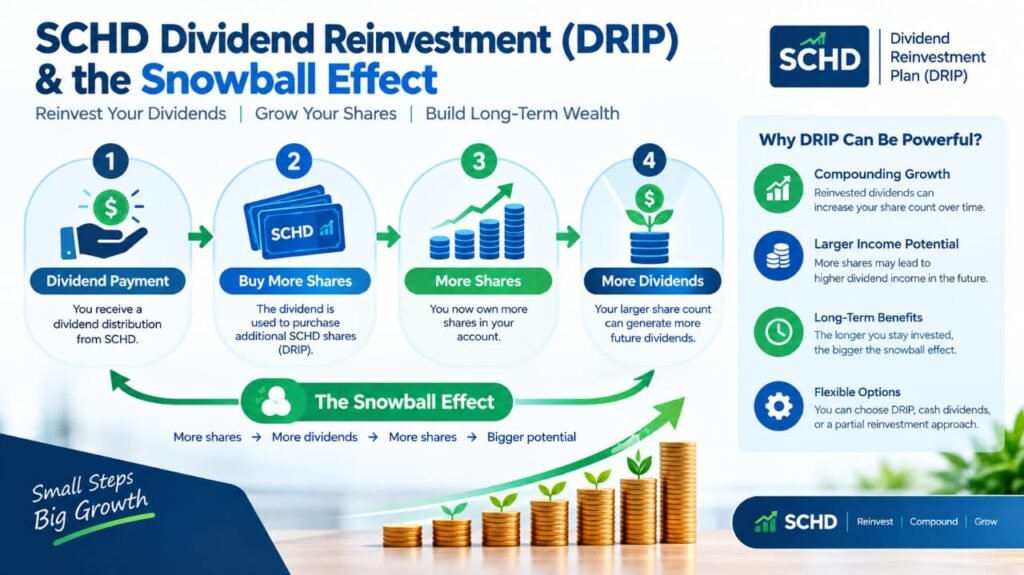
Dividend reinvestment changes what happens after each distribution. Instead of taking the cash, you use it to purchase additional shares. Those new shares can then produce future dividends.
This is the basic idea behind the dividend snowball. Over time, the number of shares can rise without requiring every new share to come from your paycheck or bank account.
What Is SCHD DRIP?
SCHD DRIP means using a dividend reinvestment arrangement to put distributions back into the investment. The exact mechanics depend on your brokerage account.
The important idea is simple. Cash that would otherwise leave the investment remains invested. This can increase future share ownership and potentially increase later dividend income.
How Reinvested Dividends Compound
The process becomes more interesting as the years pass. Dividends purchase shares. Those shares can generate more dividends. The additional dividends can purchase more shares.
That is how dividend reinvestment compounds. It doesn’t create a special type of return. It simply keeps distributions invested, allowing the share count to potentially grow over time.
SCHD DRIP vs. Taking Dividends as Cash
| Strategy | Dividend Treatment | Main Purpose |
|---|---|---|
| Cash income | Dividends are withdrawn | Current cash flow |
| DRIP | Dividends buy additional shares | Share accumulation |
| Partial reinvestment | Some cash is reinvested | Flexible income and growth |
The comparison is important because the same starting investment can produce very different future share counts. A calculator can show the difference without assuming that one approach fits every investor.
Factors That Affect DRIP Growth
The DRIP growth result depends on the starting shares, dividend amount, reinvestment timing, share price, and investment period. Recurring contributions can add another layer.
This means the SCHD dividend reinvestment growth shown by a calculator should always be read alongside its assumptions. A high projected ending value can come from aggressive assumptions rather than from dividends alone.
6. SCHD Dividend Calculator Example Scenarios
Examples make the mathematics easier to understand. Imagine two investors who each start with the same amount. One takes every distribution as cash. The other uses dividend reinvestment and continues making monthly deposits.
Their future results can diverge because the second investor is adding both new money and reinvested dividends. The following scenarios are educational examples rather than forecasts of actual SCHD performance.
Example 1: $5,000 Initial Investment
Suppose an investor starts with $5,000. The calculator uses a hypothetical 3% annual dividend yield. That produces an initial estimated dividend of about $150 before taxes.
The actual result will depend on the fund’s distribution and market price. This example simply demonstrates calculate SCHD dividend income using a round number.
Example 2: $10,000 Investment With DRIP
Now consider $10,000 with dividends reinvested. The initial income is still determined by the assumed dividend rate, but future income can change as additional shares accumulate.
| Scenario | Initial Investment | DRIP | Contributions | Main Variable |
|---|---|---|---|---|
| A | $10,000 | No | $0 | Cash income |
| B | $10,000 | Yes | $0 | Reinvestment |
| C | $10,000 | Yes | $200/month | Reinvestment + savings |
Scenario C illustrates why SCHD monthly investment can matter as much as the starting balance.
Example 3: Monthly SCHD Contributions
Suppose an investor starts with $10,000 and adds $200 every month. Over one year, the investor contributes another $2,400 before considering market movement or dividends.
This is an example of an SCHD recurring investment strategy. The actual share count depends on the price paid for each contribution, so a calculator should avoid assuming that every purchase happens at today’s price.
Example 4: Long-Term Dividend Income Goal
Suppose an investor wants $1,000 per year in dividend income. At a hypothetical 3% yield, the simple calculation would require about $33,333 of capital.
That doesn’t mean the investor will always receive exactly $1,000. Yield and distributions change. The example simply shows how much SCHD dividend income can I earn depends heavily on the assumed yield and invested capital.
Example 5: DRIP vs. No DRIP
A long-term calculator can show the difference between keeping dividends invested and taking them as cash.
| Result | DRIP | Cash Dividends |
|---|---|---|
| Shares accumulated | Potentially higher | Lower |
| Cash received | Lower | Higher |
| Reinvestment | Yes | No |
| Compounding effect | Included | Reduced |
| Future income | Depends on assumptions | Depends on remaining shares |
The key lesson is not that one method always wins. Your objective matters. Someone seeking current income has different needs from someone focused on long-term accumulation.
7. SCHD Dividend Growth & Long-Term Portfolio Projection
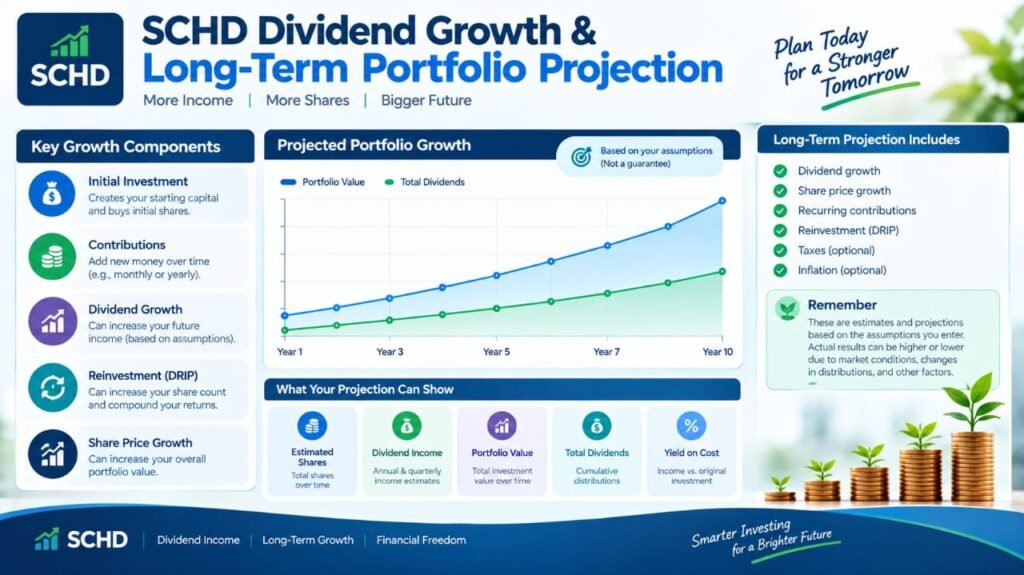
Dividend investing becomes more interesting when you look beyond the next payment. An investor may care about future income, share accumulation, and the changing value of the entire portfolio.
A useful SCHD dividend growth projection can model these factors separately. This makes it easier to see whether the result comes mainly from new contributions, reinvested dividends, dividend growth, or share-price growth.
SCHD Dividend Growth Over Time
A dividend growth assumption increases the modeled distribution over future years. For example, a 5% annual growth assumption would increase a hypothetical $1.00 dividend to about $1.05 after one year.
The important phrase is “assumption.” Historical SCHD dividend growth over time doesn’t guarantee that the same rate will continue.
SCHD Portfolio Growth Projection
An SCHD portfolio growth projection can combine initial capital, contributions, dividends, reinvestment, and price appreciation.
| Growth Component | Effect on Projection |
|---|---|
| Initial investment | Creates starting capital |
| Contributions | Add new capital |
| Dividend growth | Can increase future income |
| Reinvestment | Can increase share count |
| Share price growth | Can increase portfolio value |
This creates a more complete SCHD future portfolio value estimate than a dividend-only calculation.
Year-by-Year SCHD Projection
A year-by-year table makes a long projection easier to inspect. It can show whether the model’s growth is gradual or heavily dependent on one assumption.
| Year | Contributions | Shares | Dividend Income | Portfolio Value |
|---|---|---|---|---|
| 1 | $2,400 | — | — | — |
| 2 | $4,800 | — | — | — |
| 3 | $7,200 | — | — | — |
| 5 | $12,000 | — | — | — |
| 10 | $24,000 | — | — | — |
The blank fields should be calculated from the user’s chosen assumptions. That prevents a generic table from being mistaken for an actual SCHD forecast.
Yield on Cost
How to calculate yield on cost is simple. Divide current annual dividend income by the original amount invested, then multiply by 100.
For example, if an investment originally cost $10,000 and now produces $500 in annual dividends, the yield on cost is 5%. This can differ greatly from the ETF’s current market yield.
How Inflation Affects Future Dividend Income
Inflation changes what future dollars can buy. An investment might produce more dollars ten years from now, yet those dollars could have less purchasing power.
For this reason, advanced projections can include inflation-adjusted returns. The goal is to understand both nominal income and potential real purchasing power.
Taxes and SCHD Dividend Income
Taxes can reduce the amount of dividend income you actually keep. The treatment can depend on account type, holding period, income level, and the classification of the distribution.
For U.S. investors, qualified dividends may receive different federal tax treatment from ordinary income. A calculator should therefore treat dividend tax assumptions as estimates and encourage readers to check current IRS rules or consult a qualified tax professional.
8. SCHD vs. Other Popular Dividend ETFs
SCHD is one of several U.S. dividend-focused ETFs. Comparing funds requires more than looking at the highest displayed yield. Each fund can use a different index, screening process, portfolio construction method, and expense structure.
For example, investors may compare SCHD with VYM, DGRO, or HDV. These funds can have different objectives and holdings. The purpose of a comparison is to understand those differences rather than reduce everything to one number.
SCHD vs. VYM
VYM and SCHD both provide exposure to dividend-paying U.S. companies. Their index methodologies and portfolio construction differ.
The SCHD ETF currently tracks the Dow Jones U.S. Dividend 100 Index, while its fund characteristics are reported by Schwab as passive.
SCHD vs. DGRO
DGRO is another dividend growth ETF that emphasizes companies with dividend-growth characteristics. Its construction differs from SCHD’s methodology.
When comparing them, investors can examine dividend history, holdings, expense ratios, sector exposure, and total-return behavior. A higher current yield does not automatically mean higher total returns.
SCHD vs. HDV
HDV is another dividend-oriented ETF with its own selection methodology. Its portfolio can therefore look different from SCHD even though both funds target dividend-paying stocks.
A meaningful comparison should include the index, number of holdings, sector exposure, distributions, expenses, and historical volatility rather than focusing on one statistic.
What Makes Dividend ETFs Different?
The term dividend ETF covers many strategies. Some focus on high current yield. Others focus on dividend growth, quality, value, or a combination of factors.
SCHD’s official fund profile lists 102 holdings as of September 10, 2026 and a 0.060% total expense ratio. Its exact characteristics can change over time.
9. Is SCHD a Good Investment for Dividend Income?
Whether SCHD fits an investor depends on the investor’s goals, time horizon, risk tolerance, and broader portfolio. A dividend-focused ETF can be useful for studying income and growth together, but distributions and market values can change.
Schwab describes SCHD as an ETF tracking the Dow Jones U.S. Dividend 100 Index. Its official materials also show that investment value fluctuates and past performance isn’t a guarantee of future results.
What Type of Investor Might Use SCHD?
An investor interested in U.S. dividend-paying companies may study SCHD as one possible ETF. Someone focused on long-term income might also examine reinvestment, dividend growth, and portfolio diversification.
The important point is that SCHD income from dividends is only one part of the investment experience. Price changes can increase or decrease portfolio value while dividends can change independently.
Potential Benefits to Consider
SCHD offers exposure to a basket of U.S. companies through one ETF. It also has a long operating history, quarterly distributions, and a relatively low stated expense ratio.
These characteristics may make the fund interesting for research. They don’t remove market risk or guarantee dividend growth. Schwab’s current data should be used when evaluating the fund.
Risks and Limitations to Consider
The SCHD dividend payout isn’t guaranteed. Companies held by an ETF can change their dividends. The ETF’s market price can also decline.
Sector exposure, economic conditions, interest rates, valuation changes, and company-specific events can affect results. A calculator cannot remove those risks. It can only model selected assumptions.
Questions to Ask Before Investing
Before relying on a projection, consider whether you need current income, long-term growth, or both. Think about how much money you can invest and how long you can leave it invested.
Also consider whether you plan to reinvest distributions. These choices can materially change an SCHD passive income projection, even when the starting investment remains identical.
10. SCHD Dividend Calculator FAQ
The most useful FAQ answers practical questions that investors ask before using a calculator. The answers should stay simple because dividend calculations become confusing when basic concepts are mixed together.
The key is to separate current facts from projections. Current distributions come from fund data. Future results depend on assumptions about dividends, prices, contributions, taxes, and reinvestment.
What Is the SCHD Dividend Calculator Used For?
The calculator is designed to estimate potential dividend income and long-term investment results. It can help you calculate SCHD dividend income, compare DRIP scenarios, and examine different investment periods.
It should be viewed as an educational planning tool. It cannot guarantee a future dividend or portfolio value.
How Much Dividend Does SCHD Pay?
SCHD pays distributions quarterly. The amount isn’t fixed at one permanent number. Schwab’s distribution history shows different quarterly income distributions across different periods.
For an accurate current figure, use the latest official fund data rather than relying on an old article or screenshot.
How Much SCHD Do I Need to Make $1,000 a Year?
The basic calculation is annual income divided by assumed dividend yield. At a hypothetical 3% yield, $1,000 would require about $33,333 of invested capital.
This is only a mathematical example. The actual amount can change as the SCHD dividend yield, share price, and distributions change.
How Much SCHD Do I Need to Make $500 a Month?
$500 per month equals $6,000 per year. At a hypothetical 3% yield, the simple calculation would require about $200,000.
Again, this doesn’t guarantee $500 in monthly cash flow. SCHD generally distributes quarterly, so annual income and monthly budgeting are two different concepts.
Does SCHD Pay Dividends Every Month?
No. SCHD’s official distribution history shows a quarterly schedule. Individual payment amounts can vary between quarters.
Therefore, an investor seeking monthly spending money may need to budget quarterly distributions across the year instead of expecting a payment every month.
Does SCHD Have a DRIP?
Dividend reinvestment can generally be arranged through brokerage accounts that support a dividend reinvestment plan.
The exact process can differ between brokers. Investors should check their brokerage settings to confirm whether automatic reinvestment is enabled and how fractional shares are handled.
How Does SCHD Dividend Reinvestment Work?
The basic process is simple. A distribution is credited to the account. Instead of keeping it as cash, the investor uses it to purchase additional shares.
That is how SCHD DRIP works at a conceptual level. More shares can create more future dividend income if distributions continue.
Can I Calculate SCHD Dividends With Monthly Contributions?
Yes. A calculator can model SCHD dividend projection with recurring contributions by adding new investment at regular intervals.
However, each contribution may purchase a different number of shares because the market price changes. A realistic model should account for this instead of assuming one permanent purchase price.
Can the Calculator Include Dividend Growth?
Yes. An assumed dividend growth rate can be used to model possible future income. This can make a long-term projection more informative.
The important limitation is that the growth rate is an assumption. Historical growth doesn’t guarantee that future distributions will increase at the same rate.
Does the Calculator Include Taxes and Inflation?
An advanced model can include both. A SCHD dividend calculator with taxes can estimate after-tax income using an assumed tax rate. A SCHD dividend calculator with inflation can also estimate the future purchasing power of that income.
These calculations are only estimates because individual tax treatment and future inflation can differ.
Are SCHD Dividend Calculator Results Guaranteed?
No. Calculator results are projections based on the assumptions you enter. They don’t guarantee dividend payments, market returns, or future portfolio values.
The best way to use a calculator is to test several reasonable scenarios. Compare conservative and optimistic assumptions instead of treating one projected number as a promise.
FAQ
- How can I calculate the dividend amount I will receive from SCHD?
Multiply your SCHD shares by the expected dividend per share. For a projection, use the calculator to include dividend growth and reinvestment.
- How much SCHD to make $1,000 a month in dividends?
You need $12,000 in annual dividend income. The required investment depends on SCHD’s assumed dividend yield.
- How much will I receive in SCHD dividends if I invest $20,000?
It depends on the current dividend yield and distribution amount. Enter $20,000 into the calculator for an estimate.
- Can you provide a calculator to calculate dividend income?
Yes. The SCHD Dividend Calculator can estimate dividend income, shares, reinvestment, and potential portfolio growth.
- How much money do you need to make $50,000 a year off dividends?
At a hypothetical 3% yield, you would need about $1.67 million. The actual amount changes as dividend yields change.
- What is the 25% dividend rule?
The 25% dividend rule generally refers to limiting dividend income withdrawals or using a 25% allocation guideline, but it isn’t a universal investing rule.
Final Thoughts on SCHD Dividend Income and Growth
A dividend calculator becomes most useful when it helps you understand the relationship between money invested, shares owned, distributions, reinvestment, and time. The goal isn’t to predict one perfect future number. The goal is to understand how different assumptions change the outcome.
For U.S. investors researching SCHD, current fund data should come from reliable sources. Schwab’s official page provides fund characteristics, distributions, performance information, and other details that can change over time.
The biggest lesson is simple: future SCHD dividend income depends on more than today’s yield. Your starting capital, contributions, dividend growth, share-price movement, and reinvestment choices can all influence the result. Use the calculator to explore those relationships before making financial decisions.
Important: Calculator projections are estimates for educational purposes. They aren’t guarantees of future dividends, investment returns, or portfolio value. Market prices and distributions can change. Tax treatment also varies by individual circumstances.

Welcome to SCHD Calculators! I’m Saim Raza, a Paid Advertising & SEO Professional with 2.5 years of hands-on experience.
I specialize in Meta Ads (Facebook & Instagram), TikTok Ads, Google Ads, and YouTube Ads. I also work with SEO to help websites improve visibility, attract traffic, and grow online.
My goal is to make digital marketing simple, practical, and effective for businesses worldwide.
Pingback: 7 Easy SCHD Dividend Payout Calculator | Estimate Dividends